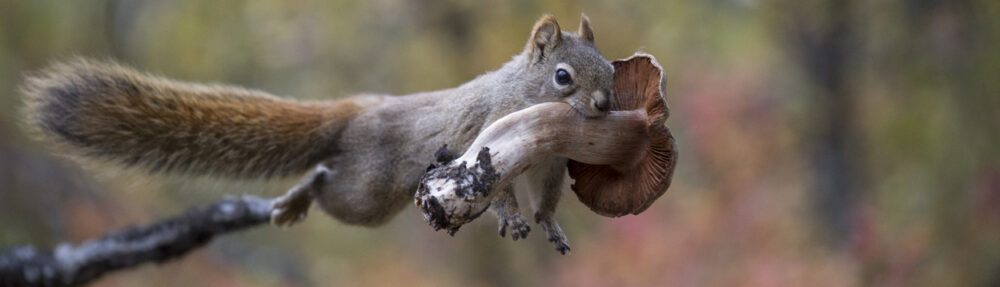
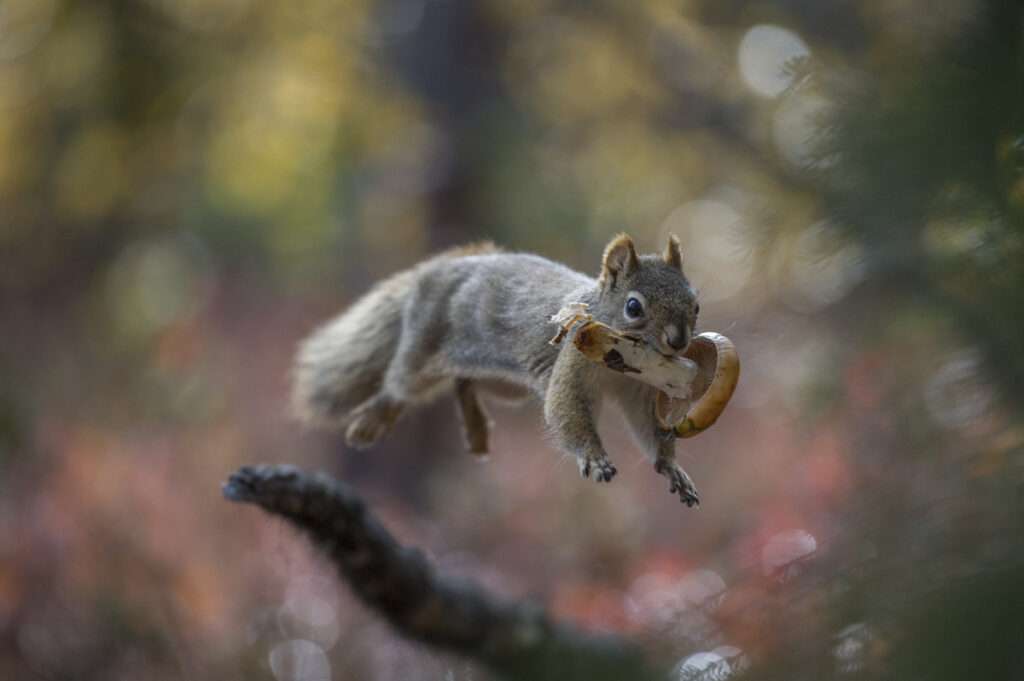
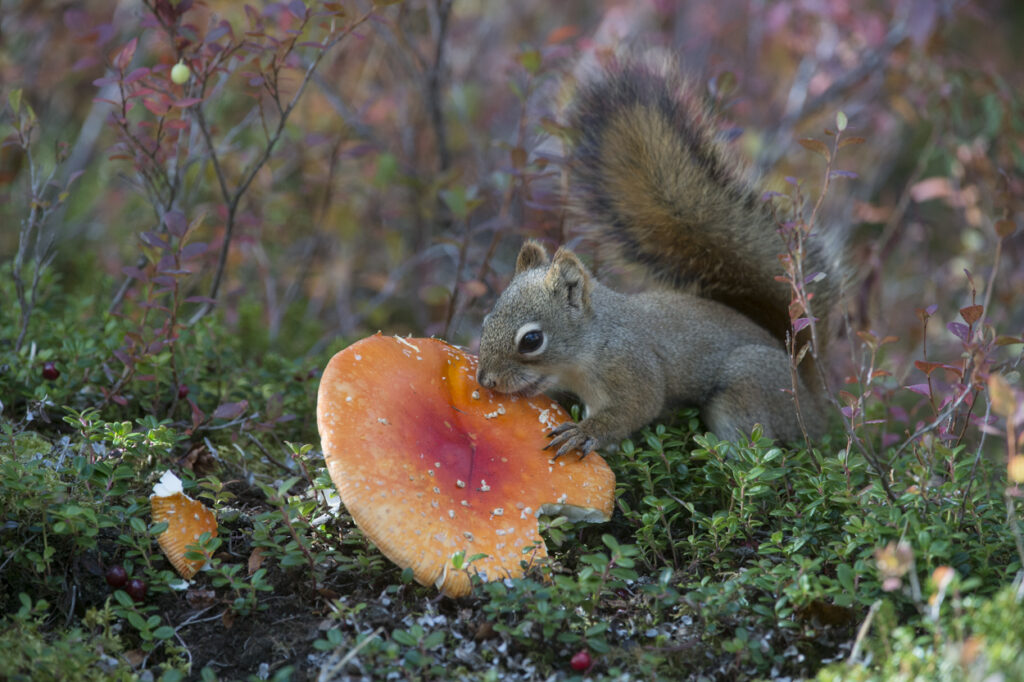
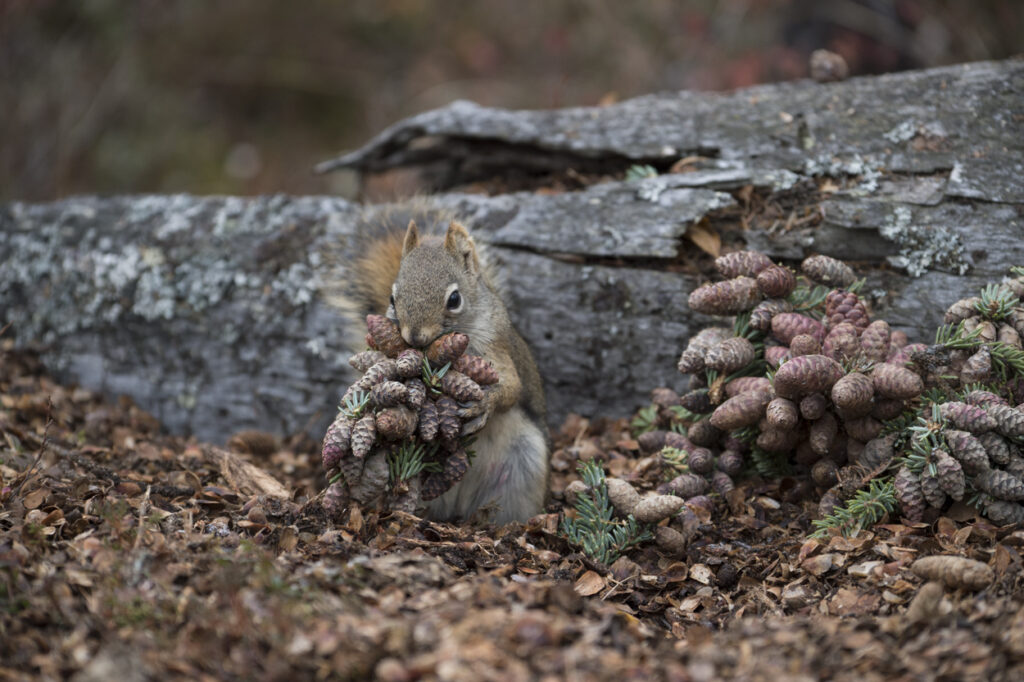
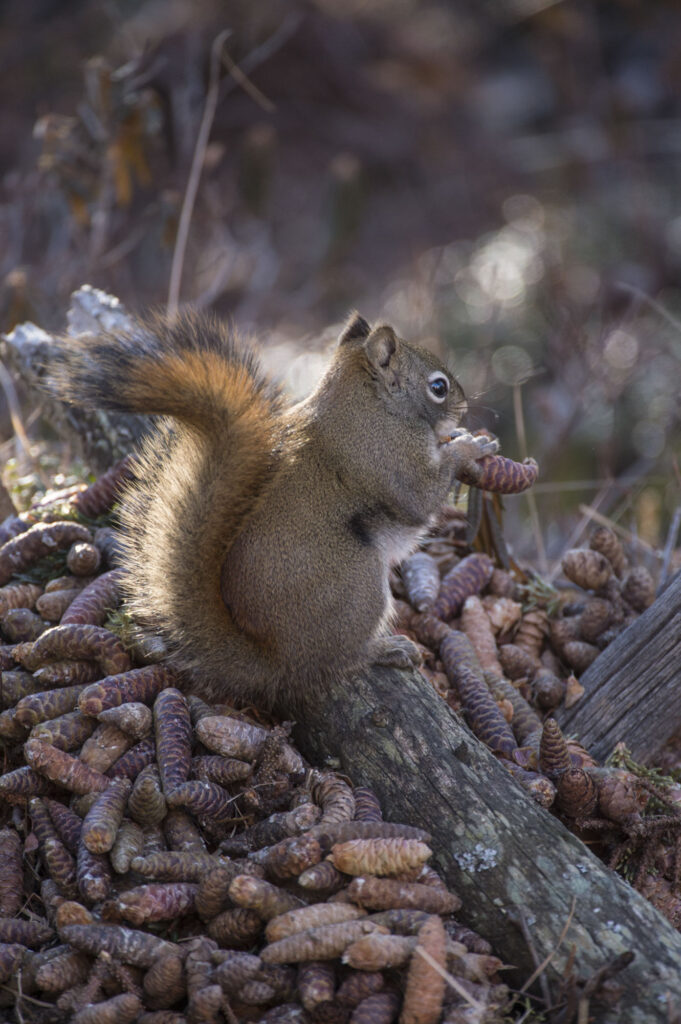
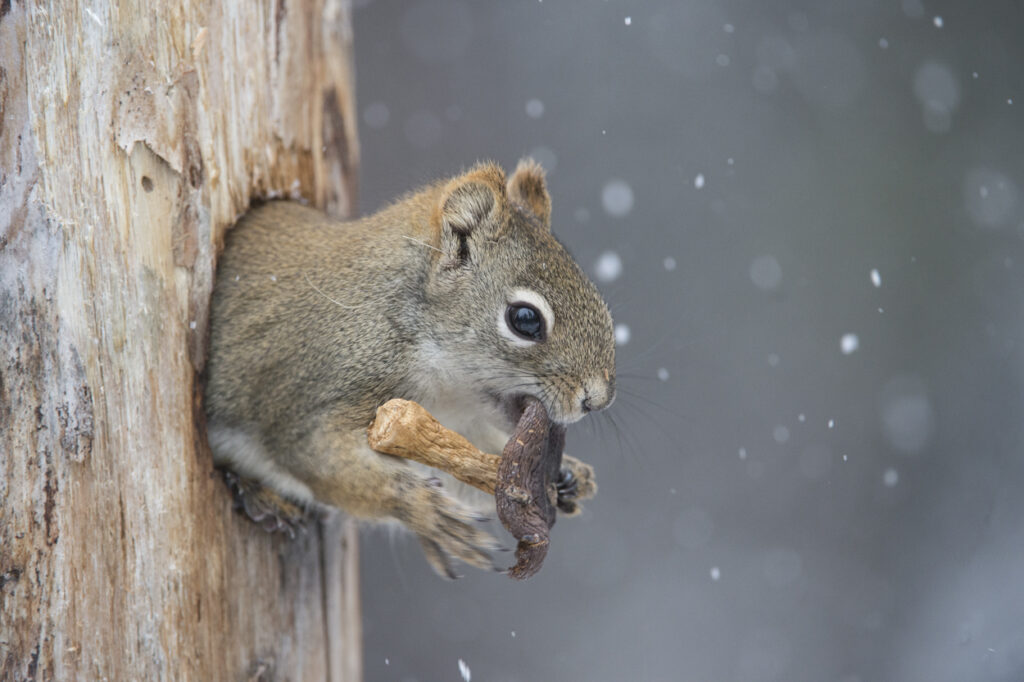
Each fall red squirrels (Tamiasciurus douglasii) begin a frenzied preperation for the coming Alaskan winter by gathering mushrooms and spruce cones. Their hoarding behavior provides crucial survival benefits.Read more: HOARDING TO SURVIVE
Red squirrels are naturally shy and cautious, ever alert for predators such as lynx and northern goshawks, specialists in hunting these tough rodents. Red squirrels have the ability to eat toxic mushrooms including these (Amanita muscaria)
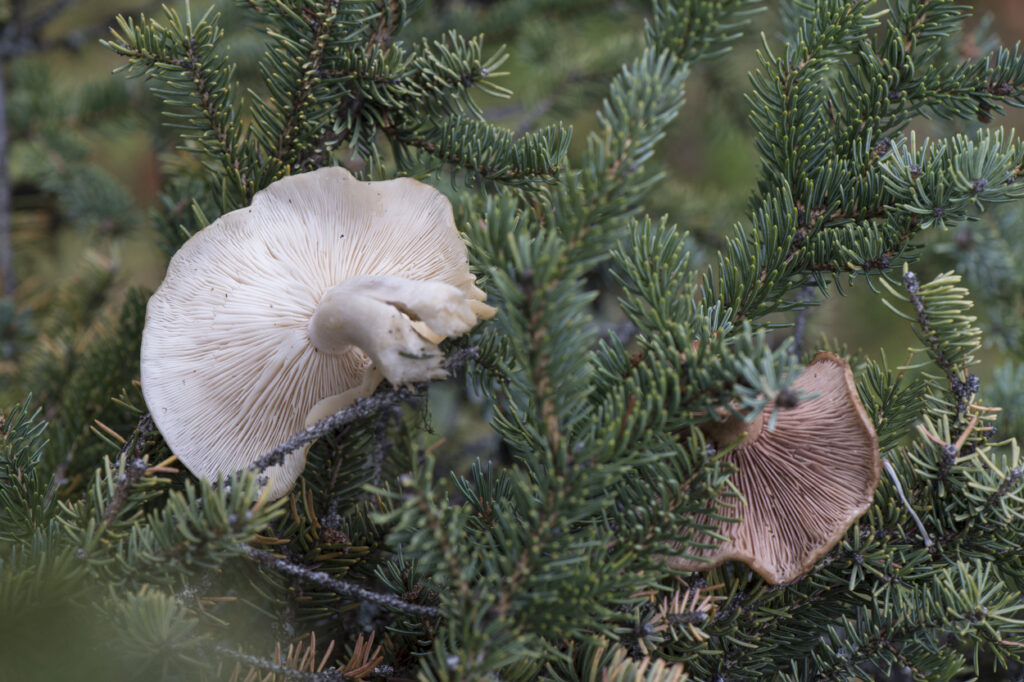
Mushrooms are laid out on spruce boughs to dry, then cached in cool, dry place. I found nearly ten gallons of dry mushrooms the red squirrel had cached in our sauna.
From a squirrels perspective, spruce cone production is not always something to chatter about. It can fail over huge areas, making mushrooms very important.
But some squirrels have their pantries still bulging with cones buried last year in stashes around their territories. Buried cones stay cool, moist and tightly closed, their tiny seeds within.
Spruce cone clusters stashed at a squirrel midden.
Red squirrels often gather and store more than they will use during the six months of winter, spruce cones cached underground are good for several years.
PHOTO TIP
Hang out with them until they are quite used to your presence. (weeks to months) These photographs were taken near our wilderness home where red squirrels can become somewhat trusting but very destructive.
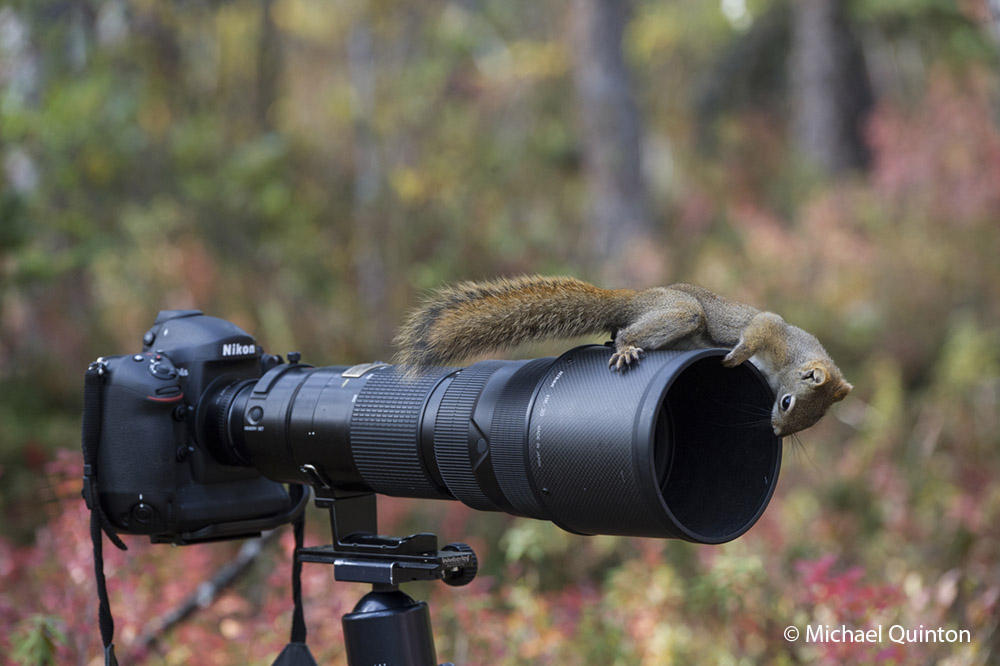
Photographing red squirrels is fun but challenging. I photographed the squirrels for more than a month to get these photographs. Sometimes the curious red squirrel is more interested in checking out my equipment than carrying on with its important work.
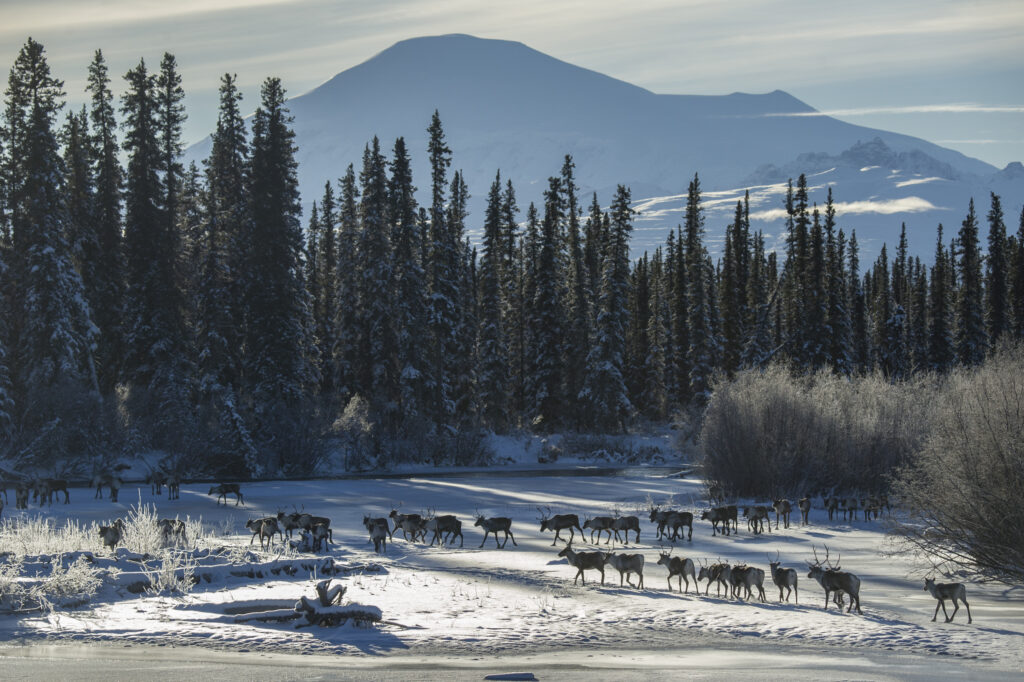
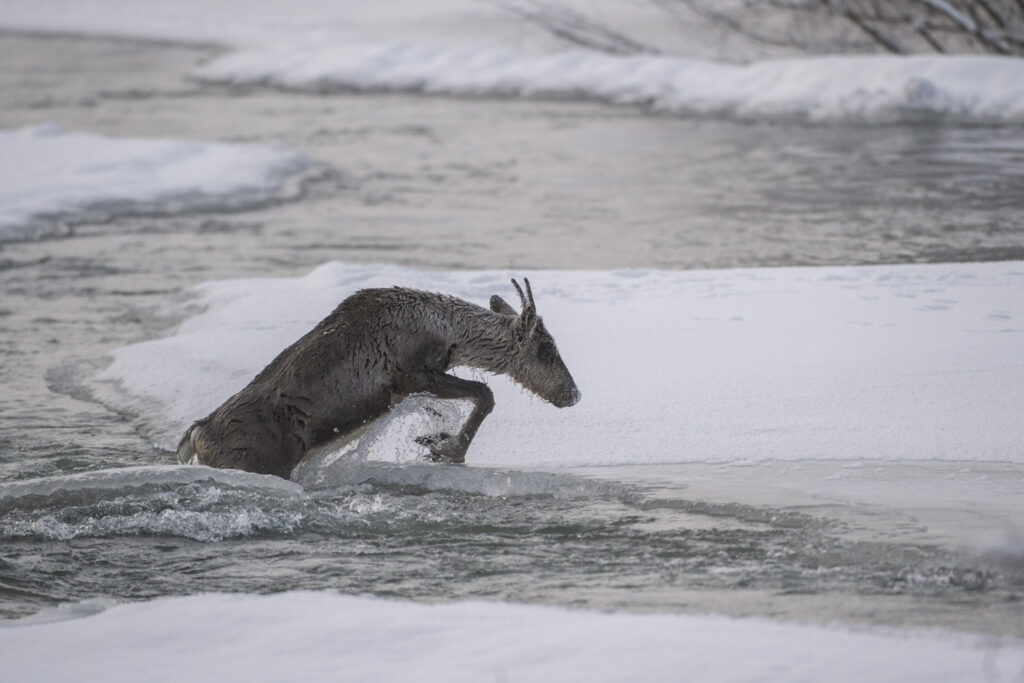
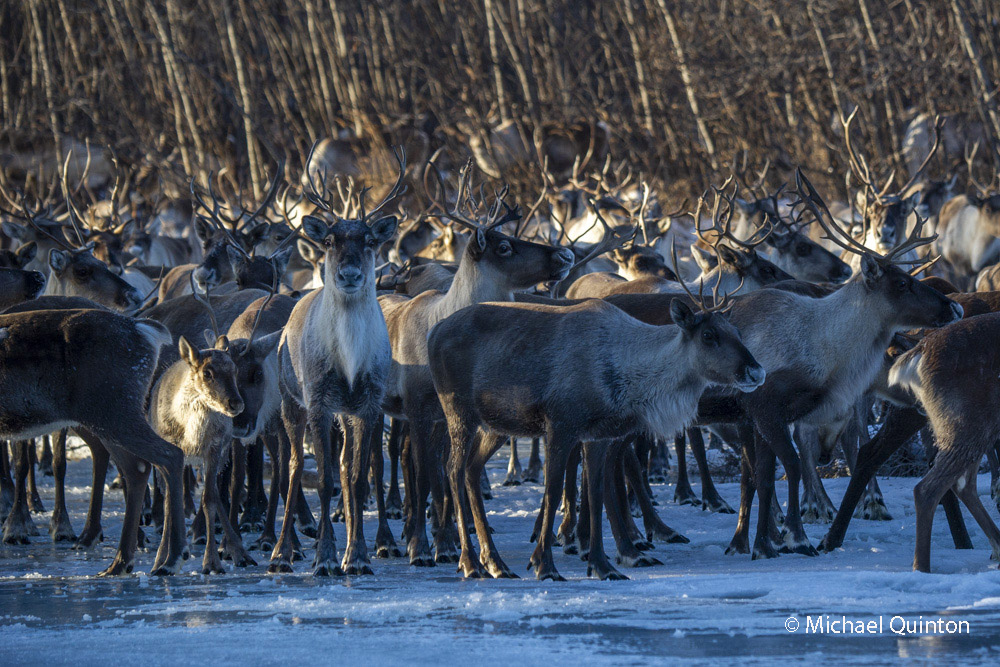
For two weeks I’d waited along this frozen river in the hopes of photographing the semi-annual caribou migration. I saw about two hundred caribou, a mere trickle compared to some years. One large group had close to one hundred fifty caribou and the remaining stragglers were in pairs or small groups. The bulk had passed to the west of here earlier.
caribou,(Rangifer tarandus) Alaska
I knew from past migrations that the freezing rivers naturally funnel the caribou to this big bend in the Copper River Basin. The river, frozen on both sides, was still open in most places down the middle. I had located four likely places on the big bend where caribou had crossed, places with enough cover for a photo ambush. I moved between my ambush points to stay warm and pack down the trail between them so I could quickly move from one to another. I think about others who had probably waited along the big bend in the Slana River to ambush caribou, Ahtna hunters. Just yards away there are old blaze marks on big spruce trees marking the trail from the mouth of the Slana River to Batzulnetas village about five miles upriver. In 1848 Ahtna warriors killed the entire group of Russian Soldiers near Batzulnetas. On most days I saw no caribou. The caribou was painfully slow, but action could come at any moment.
And when caribou are suddenly bearing down on my hide, I start forgetting things. Things like warm cabin, cold feet, and how to operate a camera. Luckily symptoms of buck fever are temporary.
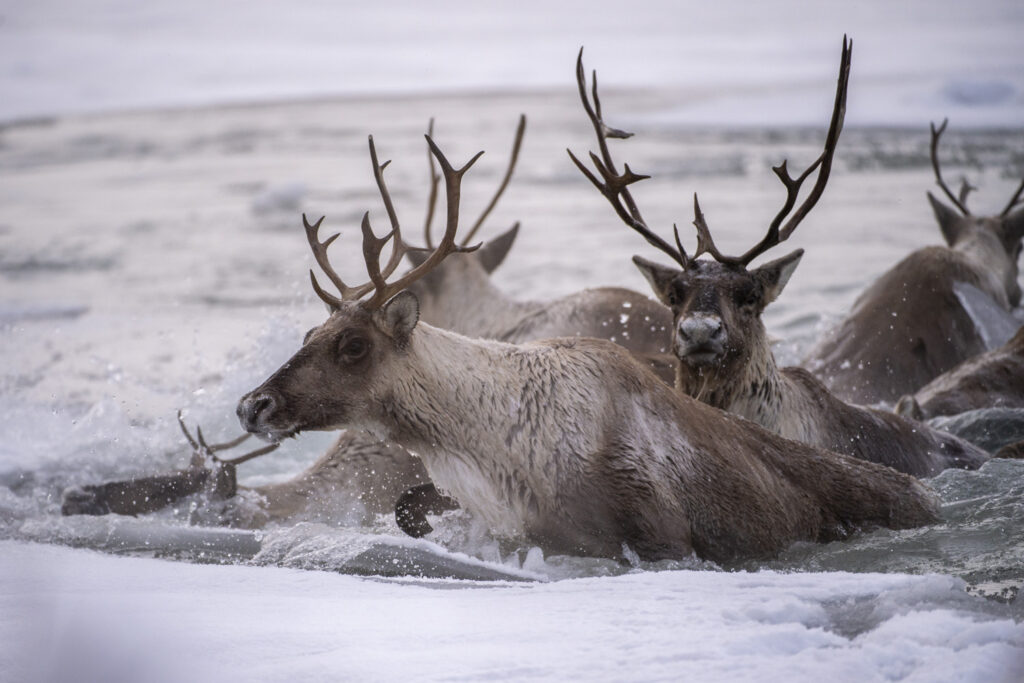
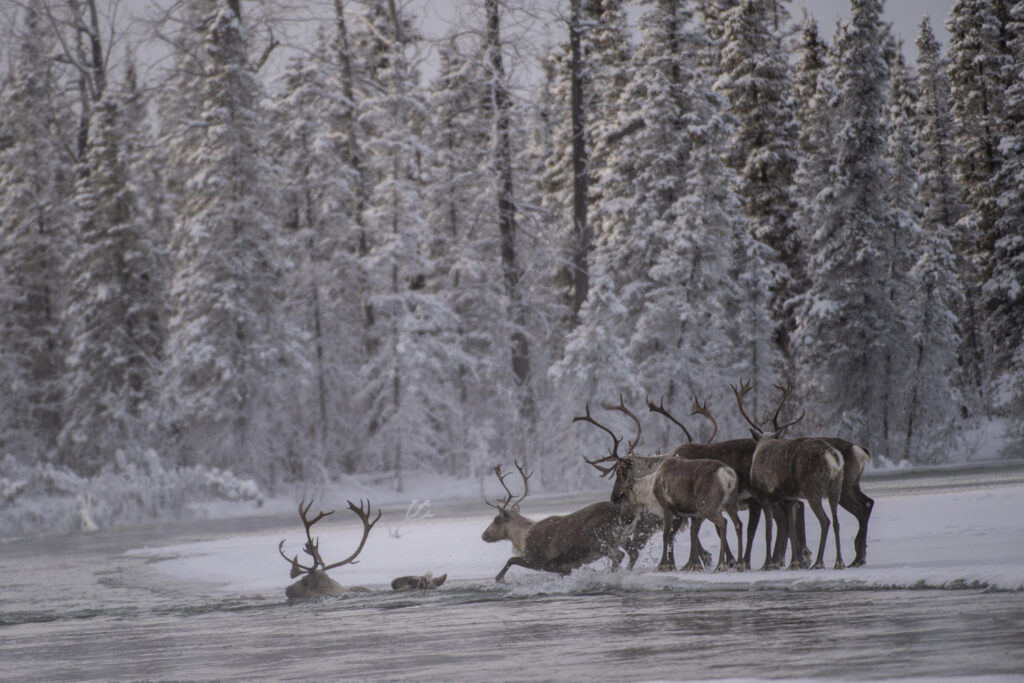
Of course more often than not the caribou would decide to cross where I wasn’t. With tripod and camera over my shoulder I hurried down my trail trying to get in camera range. Out of time and breath, I planted the tripod like a mono-pod into the snow and clicked away as they plunged in and swam across.
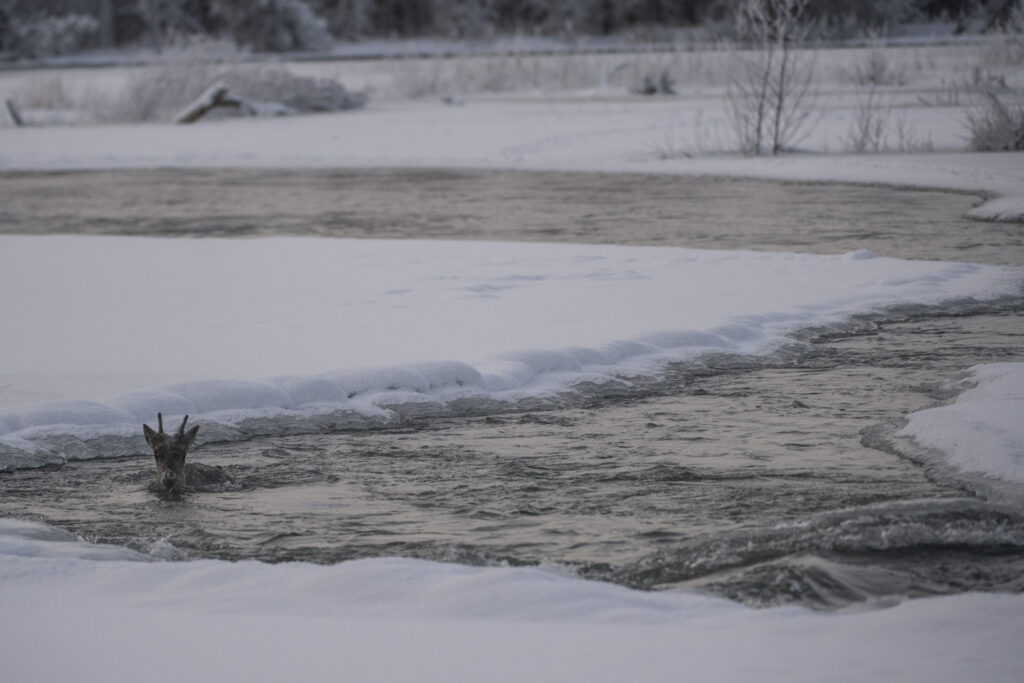
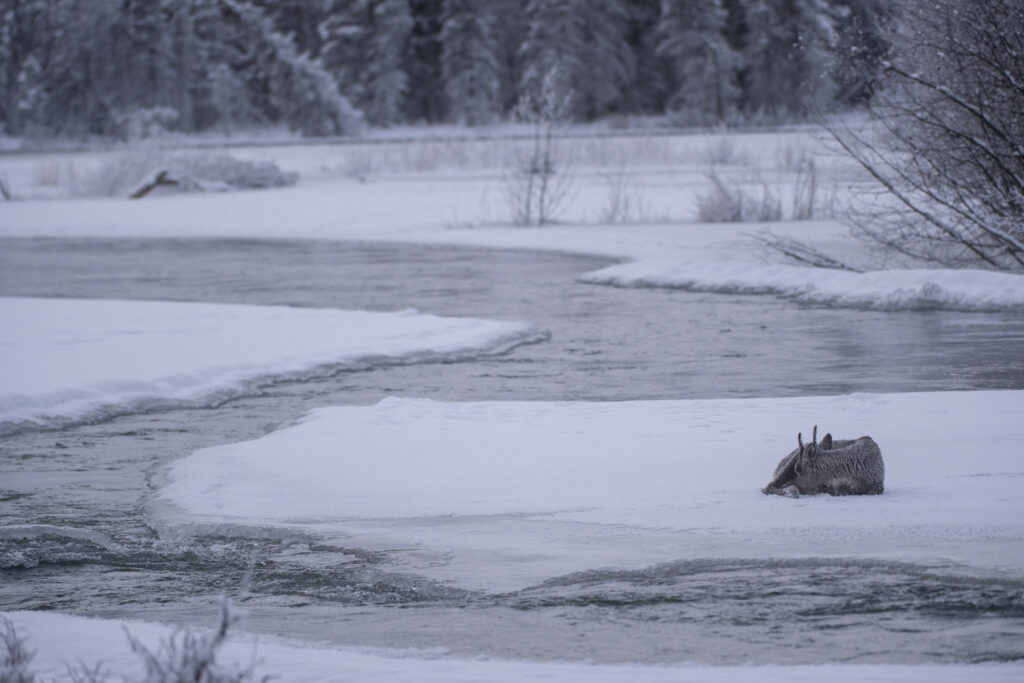
When I first noticed the caribou calf, it was in the river being carried past me by the current. He managed to climb onto an ice island in the middle of the river. After a couple of minutes he struggled to stand. Even though exhausted, the six month old calf, separated from his mom, was pressed by the urge to keep going. Walking to the edge of the ice he stepped in with a plop and swam across the ten feet of open water but did not attempt to climb out. Instead he turned back to the island, climbed out, laid down and curled up.
The calf was in trouble. I stayed hidden knowing if he saw me now he might panic and jump back into the dangerous river. Resting now would increase his odds for survival. The six month-old calf was still asleep on the ice as the winter light faded. As I slowly moved away my gut told me this young caribou was a survivor.
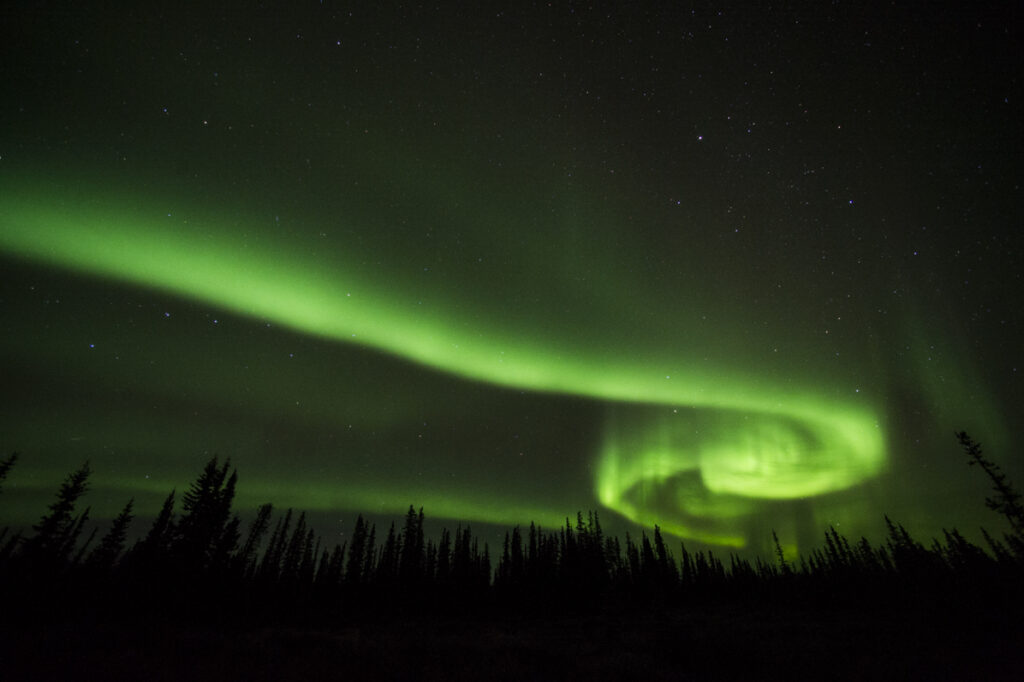
As bands of green aurora above the northeast horizon warmed up, a bear worked his way through twisted and stunted silhouettes of stunted black spruce. Air currents, rich and spicy, drifting from the cabin.
The grizzly lurked, listening, smelling, scratching, moving, waiting, salivating. It was a wary approach for a beast who reigned the night. Satisfied, the grizzly circled the cabin on a small wooden walkway, smelling, pushing, grunting, testing. At the back of the cabin, odors were particularly strong. Half standing, he placed his huge paws on either side of the 2-foot window. He started with a gentle shove. The wall creaked and popped. The window, frame and all, fell into the cabin. The grizzly’s massive head and neck filled the window opening, and he got a real good whiff. He liked the sound of cans hitting the floor. He had struck the mother lode, the well stocked pantry of Deirdre Higgins’ bush cabin. Then as the aurora danced, the great grizzly stepped off the walkway, disappearing into the night.
NEW PIONEERS OF THE LAST FRONTIER
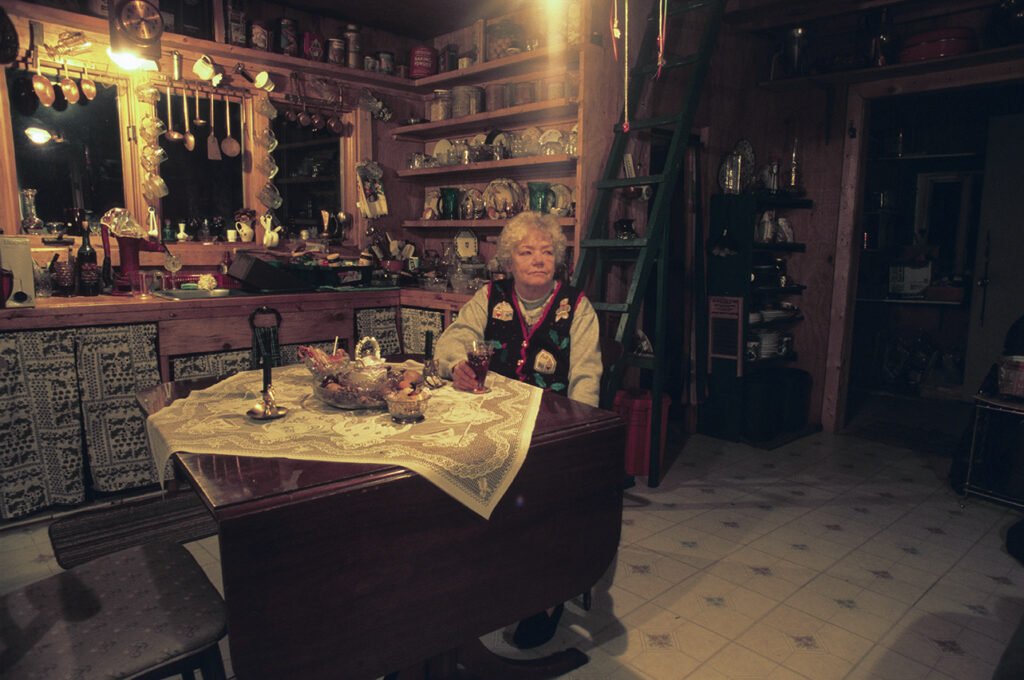
Deirdre Higgins, Slana Alaska
Deirdre came here in 1986 after hearing the call of free land. She was one of those hardy and perhaps naive breed of new pioneers who staked and filed on 5 acres of wilderness along the northern border of Wrangell/St. Elias National Park and Preserve. It was the final land giveaway, the last curtain call in the U.S. Homestead Act. Many of the new homesteaders dreamed of a subsistence lifestyle, but in reality, few would find success living off the land.
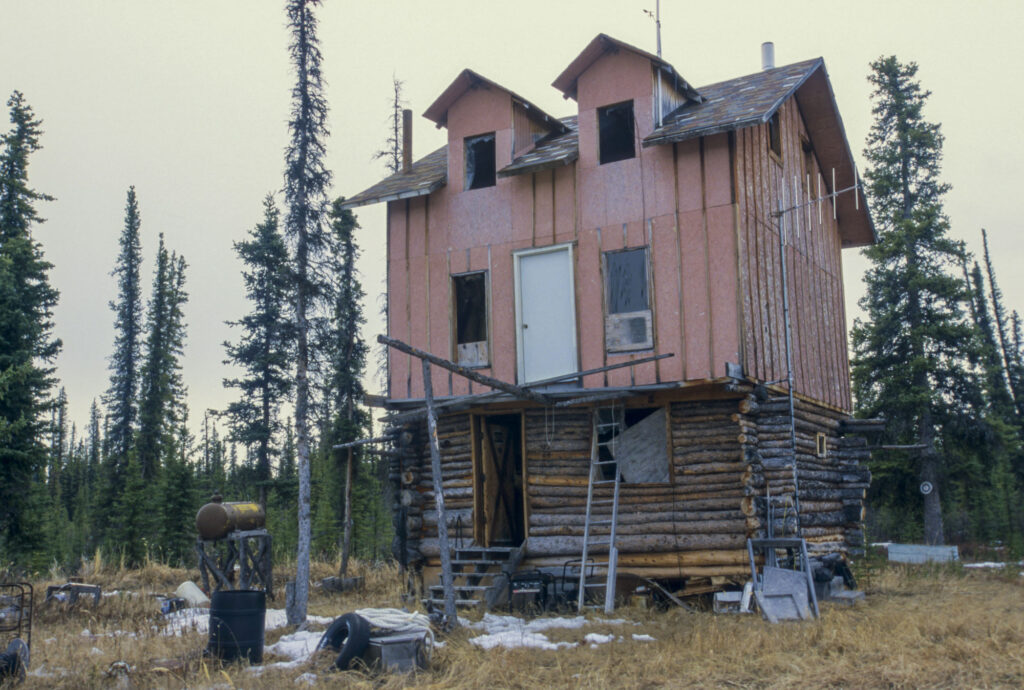
Whately’s cabin in Slana, Alaska
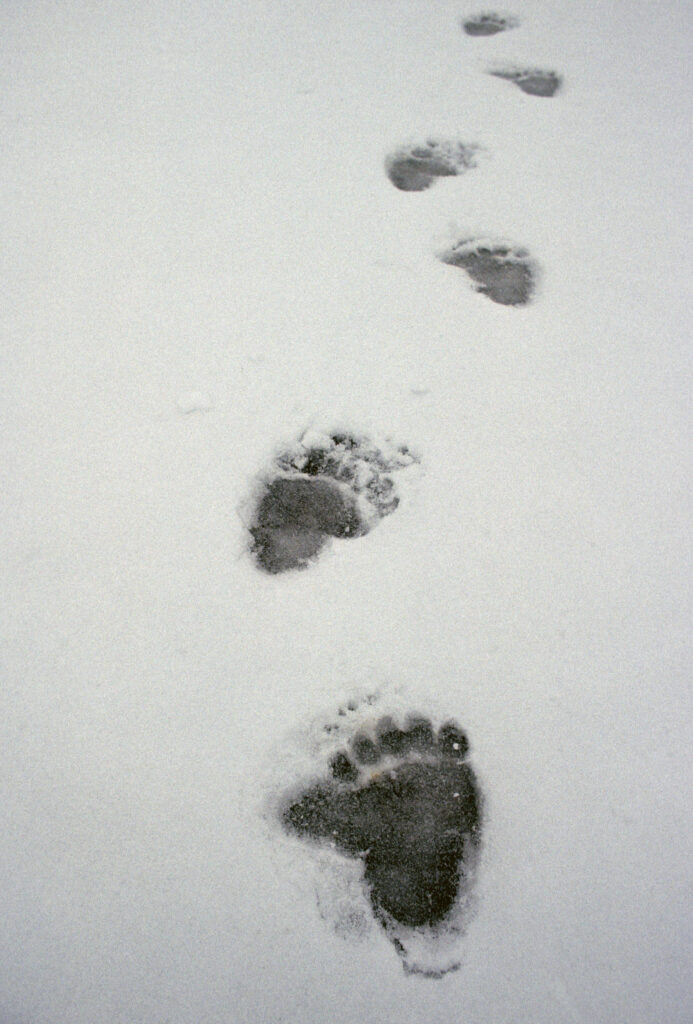
The “simple life” they had come in search of would never mean “easier.” Luxuries were few, but there was time for grayling fishing in nearby Natat Creek. On this particular day, Deirdre had dinner in mind as she crept through the brush toward her favorite hole, careful not to spook a small school of grayling. About to cast her lure into the greenish, yellow stream, she glanced down. The tracks of a big grizzly pressed deep into the muddy bank slowly materialized. Grayling forgotten, Deirdre rushed up the creek to Glen Helman’s homestead. Flushing with the excitement of her first “bear encounter,” she quickly told Glen, “There’s been a bear down at my fishing hole,” to which Glen casually replied, “Deirdre, it isn’t your fishing hole.” Deirdre didn’t have bear problems. But the summer of 2001 found her small bush cabin vacant for the first time. She had gone outside for the first time in fifteen years. I wasn’t surprised to see the big grizzly prints in the mud as I hiked the trail to check on the cabin belonging to Marie and Jim Morris, Deirdre’s daughter and son-in-law. Easily recognizable, this bear left the biggest tracks in the settlement. I had never met the grizzly that made them. Few had.
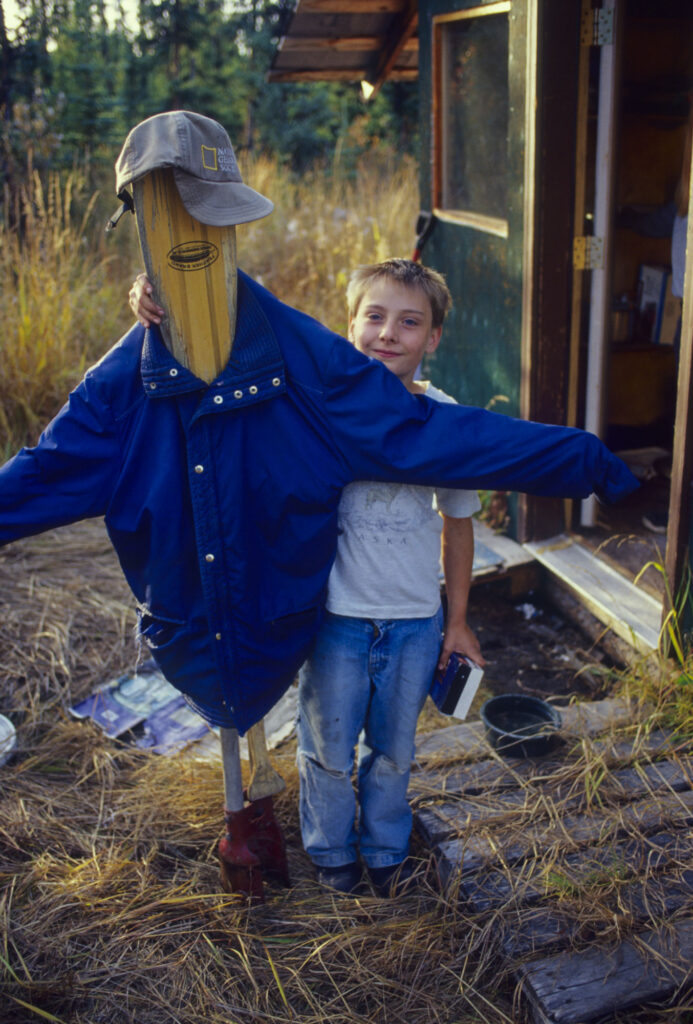
The grass had grown tall in Jim and Marie’s yard during this summer, nearly obscuring their enviable fleet of snowmobiles. But what I saw next stopped me in my tracks. The door was open into their arctic entry and pantry and had taken a direct hit. Fearing I’d blundered into the scene of a crime in progress, I searched the thick, young spruce for his dark form. I remember wishing I’d brought my bear spray, no, make that my .338 Winchester magnum. Bear trails, spoking out from the pantry into the trees, were littered with ripped, smashed and crunched boxes of cake mixes, spices, and a Crisco can. There were other cans, punctured, tasted, rejected. Apparently anything the bear wanted to give a try was hauled out to the yard. Empty packages of graham crackers, chocolate chips, and marshmallows lay close to the door. He seemed to like s’mores! Marie’s mom, Deirdre, lives just 100 yards down the trail. I checked her place next and discovered that the bear had pushed her pantry window into the cabin, where it lay unbroken on a sofa. I knew my kids would want to see all the havoc the bear had caused, so with them in tow, I later returned to clean up and nail a piece of plywood over Deirdre’s window opening. Two days later, we were back to again clean up Jim and Marie’s yard and arctic entry. We salvaged what we could, filling up a couple of large boxes. Everything else went into garbage bags. We packed everything to go. Before leaving, we built a decoy using a jacket, a canoe paddle, and my hat. We left it guarding the door.
MORE GRIZZLY DISCOVERIES
Josh and friend.
At Deirdre’s cabin, the returning bear had this time pushed both doors open, breaking the door jambs. A path of carnage led from the yard into Deirdre’s pantry. He had certainly gotten over his shyness. Why had the grizzly suddenly left Deirdre’s pantry after pushing in the window on his earlier visit? Had he lost his nerve? Already had a full stomach? , thinking about going straight? Or was this the Modus Operandi of a career criminal, a bear with enough Slana street smarts to still be wearing his hide? In the yard, a large Crisco can had been licked clean. Two jars of homemade chili had been carried outside too, their tops bitten off and the contents partially licked out. He had eaten everything—glass and all! An entire case of Tones Spicy Spaghetti Seasoning littered the cabin entrance. A couple of bottles had been spilled and tracked in and out of the cabin. It reeked of Spicy Spaghetti. A small can of cat food, punctured by some very big canines, oddly, was empty. He’d sucked out all the contents.
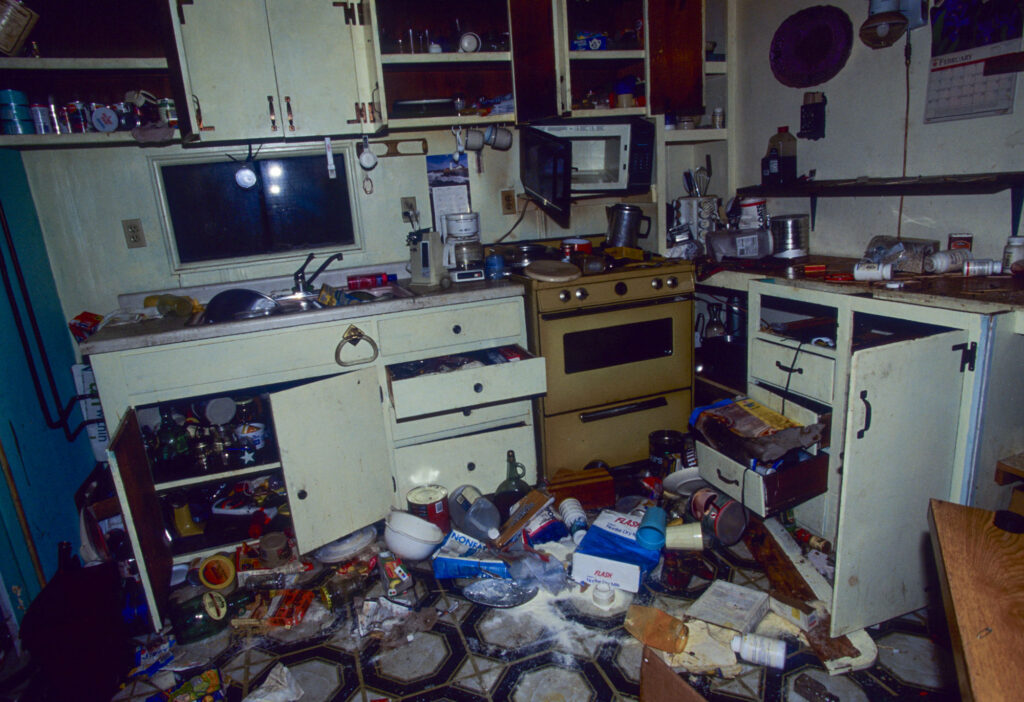
Glen Helmans kitchen after grizzly got done.
Alaska
At Glen Helman’s place, the kitchen was in shambles. Glen had passed away the year before, but the kitchen had never been cleaned out. The kitchen cupboards still stored enough food to keep the grizzly bear interested. The bear had broken windows and doors and tossed the full sized refrigerator around like an empty box. Glen’s cat Sammie was living alone now. Sometimes as I approached Glen’s place, I would see him run up the back steps, climb the broken screen door and disappear into the attic. Did Sammie hide up there, too, when the grizzly came visiting? Sammie maintained a scent station in Deirdre’s yard. The small scrape, scented with urine and droppings, laid claim to the homestead.
SETTING THE TRAP
The decoy at Jim and Marie’s seemed to be working, but Deirdre’s cabin was hit twice more in a week. Her yard was getting really messy, at about the same rate as her pantry was being cleaned out. I picked up a couple small decorative glass dishes out of the tall, yellowing grass. They were about half full of bear spit. Inside, more glass dishes were displayed on the kitchen table, filled with candy. I stood there next to the kitchen table, trying to picture the big grizzly sneaking in, carefully picking up delicate dishes of candy, and tip-toeing outside with his treasure.
Michael Quinton sets camera trap.
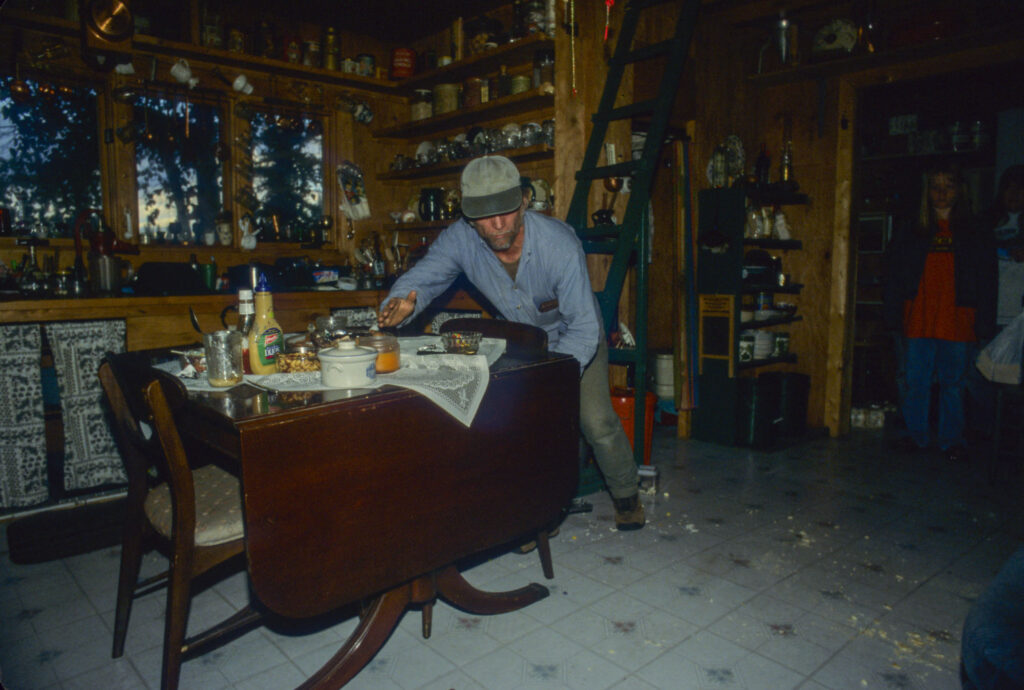
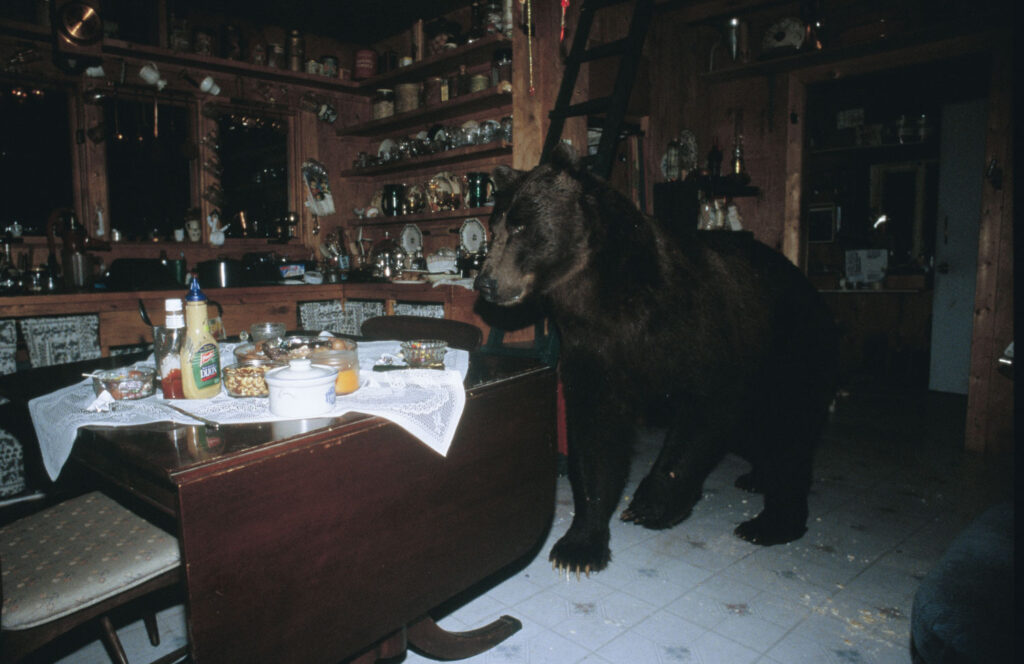
That’s when it hit me. Not in a subtle way, but with the kind of power Deirdre’s grizzly would use to knock the brains out of a bull moose. In my mind’s eye, I could visualize a great photograph! It just hadn’t been taken yet. Back home I readied my gear. Let’s see: Nikon F4, maybe a 24-mm lens, 400 ISO film, tripod, flash, oh yeah, batteries, .338 mag., Shutter Beam. Ready to roll, I returned to the inside of Deirdre’s kitchen, where I studied the layout. With the Shutter Beam against the south wall, I aimed its infra-red beam over the kitchen table toward a small reflector. Turn on Beam Align. Align. Turn off Beam Align. Plug camera cord to Shutter Beam. Turn on camera. Adjust settings. Look up to see if grizzly is standing in the doorway. Focus lens. Attach electronic flash. Turn flash on. Put in new batteries. Turn on flash. Adjust settings. Look out window to see if grizzly bear is in the yard. Test trigger point and camera operation. Move table 4 inches back. Grab rifle. Close both doors. Sprinkle Tones Spicy Spaghetti Seasoning in front of the door. Slowly walk back down the trail to my car, keeping a sharp eye out for the dark shape of the bear. Go home. Wait and worry.
THE BEAR FACTS AND OTHER TAILS
Bear problems were not new around the settlement. All the abandoned homesteader shacks had long since had their doors broke down and the food caches raided. Sometimes the four-pawed vandal just came and went through the door. Just as likely, he would enter or leave through a large window or, if it suited him, right through the wall. It was all the same to the big, shy grizzly. His fame grew. The bear seemed to enjoy rearing up with both front paws to cave in doors and tailgates. It was bears, of course, that caused the most problems, but then, weren’t they just taking advantage of homesteader mistakes? Leaving food in a vacant cabin. My flash batteries would not last a full 24 hours, so every morning and evening I made my way down the forest trail to Deirdre’s cabin. I moved slowly, watching and listening for sounds that might betray the grizzly’s presence at the cabin. Every morning I feared he wouldn’t come back while simultaneously fearing that he would. On the third morning, there were fresh tracks! He had come back. From a distance, I could see the cabin door was open, and my heart pounded. As I flipped the safety off, I feared I had missed the picture even more than I feared he might still be here. There was a big muddy track smack in the middle of both doors. Inside, nothing seemed to have been moved at all. I walked into the kitchen and through the beam, triggering the camera. The flash didn’t fire. But had the film advanced during the night? The camera frame counter said it all—two frames had been exposed. I quickly rewound the film and reloaded the camera. Then I noticed the scratches in the linoleum tiles. Like tracks in the snow, these marks told the story. The grizzly bear had walked right up to the table, the camera clicked, the flash fired, and he bolted out the door for parts unknown. I changed the batteries and quickly left. For two more weeks I kept the camera system operational in Deirdre’s cabin and waited for my roll of film to return from the lab. The bear didn’t return. But accounts of destruction from the far side of Mount Suslo told of his whereabouts. I had rarely been so anxious checking the results of a box of slides. The roll contained some two dozen pictures of Deirdre’s kitchen table. Most were test shots I’d triggered each time I returned to change flash batteries, just to make sure the system was working. But there was one slide identical to all the rest, except for one thing—it was the one I’d imagined before I set up the camera! Looming big and unbelievable, Deirdre’s grizzly stood at the kitchen table deciding which dish of candy to steal.